
Air Duct Cleaning Pricing Breakdown: What Diamond Bar Homeowners Pay in 2026
Most Diamond Bar homeowners will pay between $300 and $600 for a legitimate, full-system air duct cleaning in 2026. That’s the honest floor for a single-family home when the crew shows up with real equipment and actually does the work. If you’re seeing quotes well under $150, you’re not looking at a cheaper version of the same service. You’re looking at a fundamentally different job being sold under the same name.
Diamond Bar sits in a weird spot for this industry. We’re close enough to LA that the coupon mailers flood in from every direction, but far enough east that the cheap national franchises don’t always staff local crews. The result is a pricing spread that confuses everyone: $89 postcards next to $1,200 quotes for the same square footage. This breakdown explains what actually drives those numbers so you can evaluate a quote instead of just comparing digits.
Key Takeaways
- A real duct cleaning costs $300 – $600 for most Diamond Bar single-family homes, with larger or heavily contaminated systems running higher.
- The $79 – $99 special is a different service entirely: a quick vacuum of visible registers, not a cleaning of the duct system itself.
- Labor is the biggest cost driver, and honest labor takes 3 – 6 hours for an average home.
- Flex duct costs more to clean than sheet metal, and most Diamond Bar homes built since the 1980s have flex duct.
- Itemized quotes protect you. Flat-rate quotes protect the contractor’s margin.
The Price Spread Isn’t Competition. It’s Two Different Industries.
When Diamond Bar homeowners search for Duct Cleaning Diamond Bar home services, they’ll find listings from $89 to $1,400 for what appears to be the same thing. It isn’t. What separates those numbers is not markup or greed. It’s whether the crew intends to clean your ducts or just vacuum your registers while standing in your hallway.
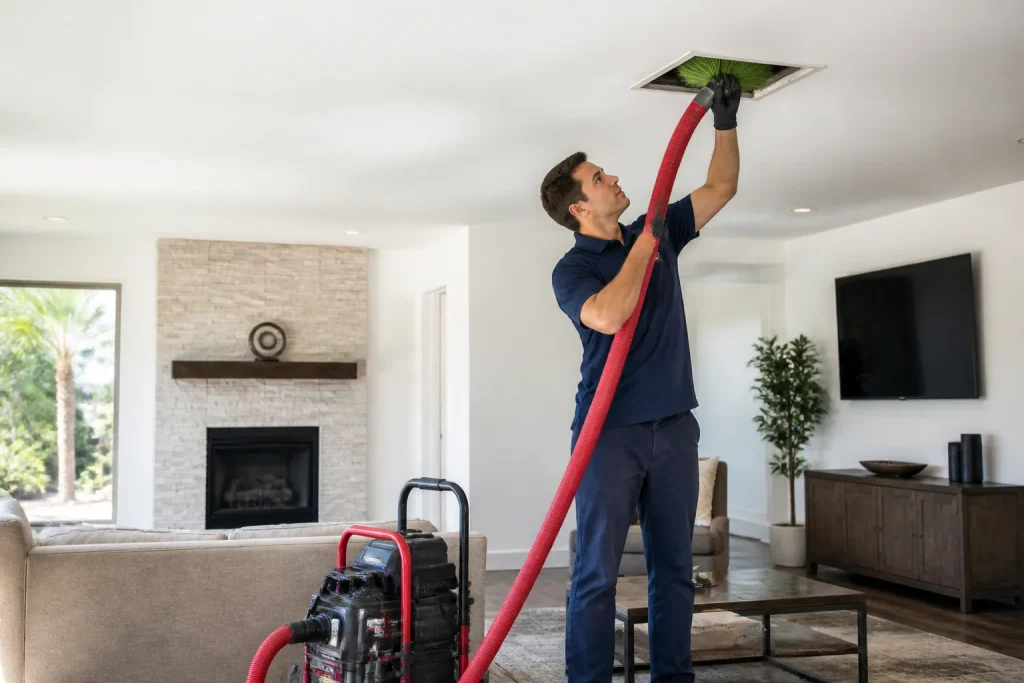
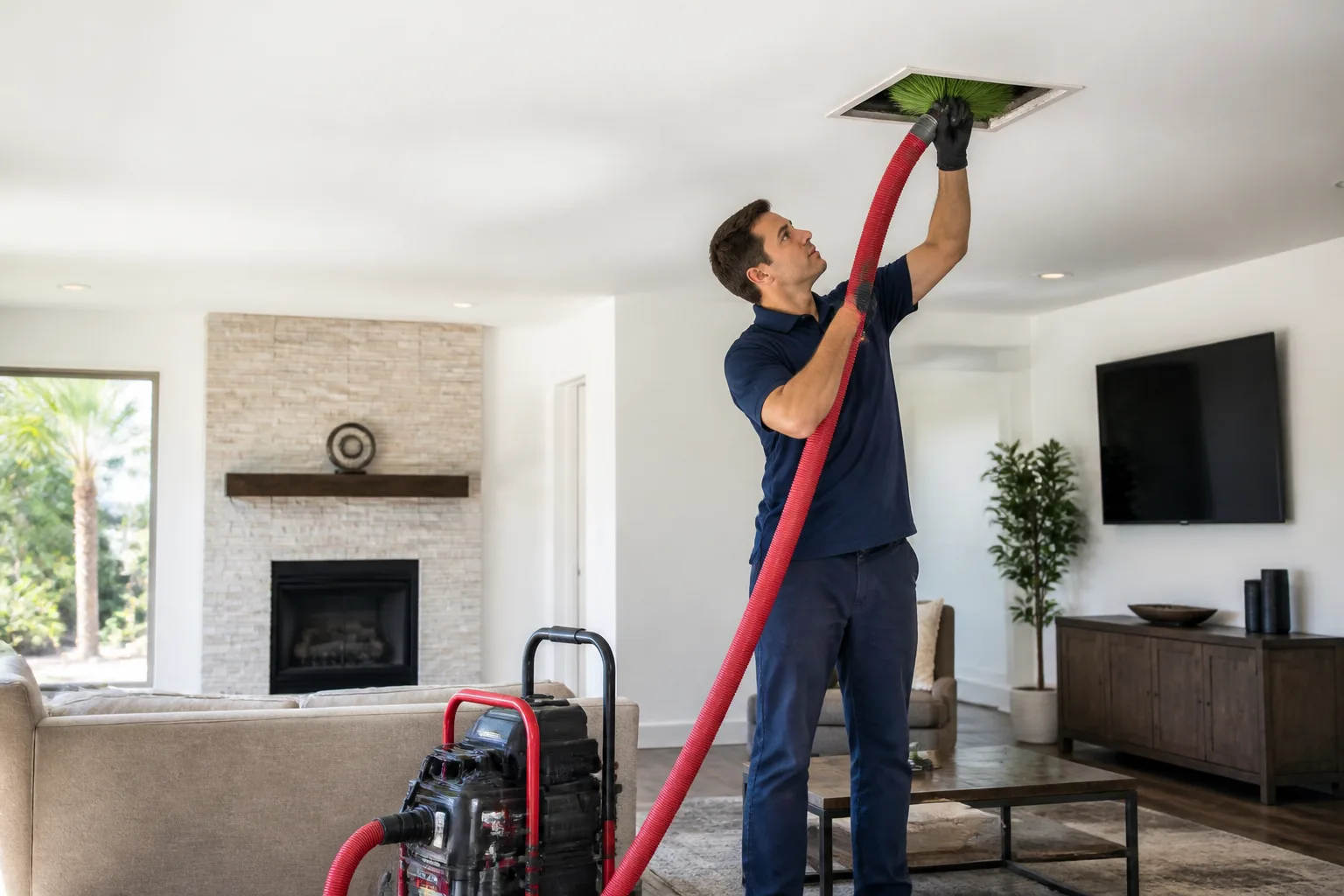
Here’s what we mean. A legitimate full-system cleaning on a 2,000 to 2,500 square foot Diamond Bar home takes two technicians between three and six hours. They’re cutting access panels, running a rotary brush line through every trunk and branch, connecting a HEPA-filtered negative air machine, and sealing everything back up. The equipment alone, the Rotobrush rotary systems and Nikro HEPA vacuums that commercial remediation contractors use, represents tens of thousands of dollars in capital that has to be depreciated across every job.
A $99 special takes one technician about 45 minutes. He’ll remove a few register covers, stick a shop-vac hose in as far as it goes, maybe run a spinning brush attachment he bought for $60, and hand you a bill for $99 plus whatever “per-vent” charges he can justify while he’s there. He hasn’t cleaned your ducts. He’s cleaned the first 18 inches of visible ductwork. The two services share a name and nothing else.
Line-Item Breakdown: What a Legitimate $300 – $600 Cleaning Actually Costs
Understanding why honest duct cleaning costs what it does requires looking at what the contractor is actually paying for. Here’s how a legitimate job breaks down line by line.
- Technician labor (2 people, 3 – 6 hours): $150 – $350. This is the biggest line item. Duct cleaning is physical work performed in awkward positions: attics in Diamond Bar summer heat, crawl spaces with limited clearance, closet access panels. Skilled labor costs $30 – $60 per hour per person, and you need two people to handle the equipment and access points efficiently. Flat-rate national franchises pay their techs less, but they also rush the job to hit quota.
- Equipment depreciation and maintenance: $40 – $80 per job. Rotary brush systems, HEPA-rated vacuum units, and compressed air whips break down under heavy use. Brushes wear out, vacuum seals degrade, motors burn out. A contractor running professional equipment has to set aside money from every job to replace it. The guy with a shop-vac and a drill attachment doesn’t have this cost because his equipment can’t physically do the work.
- HEPA filter replacement: $25 – $60 per job. A legitimate HEPA filter on a negative air machine gets used for between 8 and 15 jobs before it needs replacement, depending on how much debris it captures. In Diamond Bar, where wildfire season has been pushing fine particulate into homes for years, filters clog faster. At $200 – $400 per filter, that’s a real per-job cost the cheap operators don’t carry because they don’t run HEPA filtration at all.
- Access panel time and materials: $30 – $80 per job. You can’t clean ducts you can’t reach. Some Diamond Bar homes have convenient access points already cut. Most don’t. Cutting, framing, and sealing access panels takes time and materials. If a contractor skips this step, he’s skipping the hardest-to-reach sections of your ductwork, which are usually the dirtiest.
- Overhead and insurance: $30 – $60 per job. Vehicle costs, insurance, fuel at California prices, and basic business overhead all factor in. A legitimate operation with workers’ comp and liability coverage can’t price below these costs and stay in business.
Add it up and the honest floor for a real cleaning lands around $300 even on a small, clean home. Most Diamond Bar properties fall in the $350 – $550 range. Higher than that usually means a larger home, heavier contamination, or both.
What the $79 – $99 Bait-and-Switch Actually Delivers
We’ve followed up behind enough of these jobs in Diamond Bar to know exactly what happens. The $99 coupon gets a technician to your door. The actual cleaning, if you can call it that, involves removing register covers and vacuuming what’s visible. Then the upsell pressure starts.
The most common model is “per-vent” pricing. The $99 covers a set number of vents, usually 8 or 10. Most Diamond Bar homes have 12 to 18 supply and return registers. Each additional vent costs $12 – $25. Then there’s the “deep cleaning” upgrade, the “sanitizer application,” the “coil cleaning” that wasn’t included. By the time the technician leaves, that $99 special has become $400 – $700, for work that still wasn’t done to industry standard. The brushes never reached the trunk lines. The HEPA vacuum never ran, because there was no HEPA vacuum on the truck.
If you’re evaluating quotes right now, here’s the tell: ask whether the price covers the entire duct system or a specific number of vents. Ask whether they run negative air pressure with a HEPA-filtered unit during the cleaning. Ask how long the job will take. If the answer to the second question is anything other than “yes,” and the time estimate is under two hours, you’re not hiring a duct cleaner. You’re hiring a register vacuum with excellent marketing.
How Home Size, Duct Material, and Age Change the Price
Three factors push legitimate pricing up or down in Diamond Bar specifically.
Square footage and system length. A 1,200 square foot condo in The Country shares little with a 4,500 square foot home in The Highlands. More square footage means more supply runs, more return drops, and more time spent crawling through attics and crawl spaces. The pricing difference tracks roughly with linear feet of ductwork, not number of vents, though contractors quote by either metric.
Flex duct vs. sheet metal. This matters more than most homeowners realize. Most Diamond Bar homes built since the 1980s use flexible duct for at least part of the system. Flex duct has a ribbed interior that holds dust more stubbornly than smooth sheet metal. It also tears more easily, which is why untrained operators with aggressive rotary brush attachments can damage it. A legitimate operator knows to adjust brush speed and tension for flex runs, which takes additional time. Sheet metal cleaning runs faster, but sheet metal also shows contamination more visibly, so the standard is higher.
System age and access. Older systems, especially those in Diamond Bar homes from the 1960s and 1970s, often lack adequate access panels. The cleaning itself might be straightforward once access exists, but getting there takes longer. Older systems also carry a higher chance of discovering existing duct damage: separated joints, crushed flex runs, or gaps that have been pulling attic debris into the system for years. That’s where Air Duct Repair in Diamond Bar capability matters. A company that only cleans will either ignore that damage or charge you separately and recommend someone else. A company that diagnoses and repairs during the same visit gives you a complete result.
Itemized vs. Flat-Rate Quotes: What Each Structure Incentivizes
How a quote is structured tells you more than the number on it.
An itemized quote lists each component: linear feet of ductwork, number of supply registers, return drops, plenum cleaning, coil cleaning if applicable, access panel work, and any repairs. It forces the contractor to justify what they’re charging and gives you a document you can compare against a competitor’s itemized quote. If something gets skipped on the job, you have written proof of what was supposed to happen.
A flat-rate quote gives you one number. It’s easier to read, but it puts all the leverage with the contractor once work begins. The incentive structure inside a flat-rate job rewards speed: the faster the crew finishes, the better the margin. That’s not inherently dishonest, but it does mean the contractor’s financial interest and your air quality interest are pulling in different directions. We quote flat rates on many Diamond Bar jobs because homeowners prefer knowing the total before we start, but the flat rate is built from an itemized cost calculation, and we’re happy to show the breakdown.
What you want to avoid is the flat rate that’s suspiciously low. That’s not a flat rate. That’s a foot in the door with a bill that grows once the register covers come off.
Add-Ons Worth Considering vs. Upsells Worth Skipping
Once the crew is inside your home, you’ll be offered additional services. Some are worth paying for. Some are margin-padding with minimal air quality benefit.
- Coil cleaning: worth it if you haven’t had it done in years. The evaporator coil sits in your air handler and gets coated with the same dust your ducts carry, plus condensation that turns it into a paste. A dirty coil restricts airflow and forces your system to work harder. In Diamond Bar, where air conditioning runs from May through October, that’s real money on your electric bill. Legitimate coil cleaning involves access, solvent treatment, and rinse. It adds $75 – $150 to the job and it’s worth it if you can’t remember the last time it happened.
- Dryer vent cleaning: worth it every time. We treat Dryer Vent Cleaning in Diamond Bar as a separate safety service, not an add-on. Lint buildup in dryer exhaust is a leading cause of residential fires according to NFPA data, and most Diamond Bar laundry rooms route the vent through walls or crawl spaces where you can’t see the buildup. If your dryer takes longer than one cycle to dry a normal load, the vent needs attention. Skip it and you’re accepting a fire risk you can’t see.
- Sanitizer application: usually an upsell. An antimicrobial fog applied after cleaning sounds serious, but if the ducts are actually clean, the sanitizer has nothing to kill. Most residential systems don’t harbor the kind of microbial growth that warrants chemical treatment, and the EPA-registered products used in these applications are designed for surface treatment, not airborne distribution through ductwork. If a contractor insists you need sanitizer after cleaning the ducts properly, ask what specifically they found that requires it. If they can’t answer, save the money.
- Filter upgrades: genuinely useful, but know what you’re buying. Companies that work with Honeywell and Aprilaire systems can upgrade your filtration during a cleaning visit. A media cabinet with a MERV 11 or MERV 13 filter catches far more than a standard 1-inch fiberglass filter. If you have allergies, pets, or live near one of Diamond Bar’s canyons where wildfire smoke lingers, this is a real improvement. The key is matching the filter to your system’s static pressure capacity. A filter that’s too restrictive chokes airflow and shortens blower motor life.
The common thread in the add-ons worth your money is that they address a measurable problem. Dirty coils restrict airflow. Lint-filled vents catch fire. Weak filtration lets allergens through. The ones worth skipping are the ones that can’t tell you what problem they’re solving.
When to Call a Pro (and When It Can Wait)
Duct cleaning isn’t an emergency service, and honest contractors will tell you that. Most Diamond Bar homes benefit from a full-system cleaning every 3 to 5 years, with tighter intervals if you’ve renovated recently, kept pets indoors, or live near open space where dust and particulate loads run higher.
Here’s when to stop researching and make the call. You see visible dust puffing from registers when the system kicks on. You’ve had any water intrusion in the attic or crawl space that reached the ductwork. You can see dust accumulation inside the register openings with a flashlight, or worse, smell mustiness when the air runs. You found rodent or pest evidence anywhere near the duct runs. You’ve just finished drywall work, flooring replacement, or any renovation that generated fine dust.
If you’re in the Diamond Bar area and want a straight answer about your system before you commit to anything, the Air Duct Cleaning in Diamond Bar page covers our process in detail. We use Rotobrush rotary systems and Nikro HEPA-filtered vacuums on every job, which means we’re physically dislodging and capturing debris, not pushing it around inside your ducts. The equipment matters, and it’s the first question you should ask any contractor you’re considering.
The Bottom Line
Diamond Bar homeowners should budget $300 to $600 for a legitimate full-system cleaning, with larger homes and heavier contamination pushing toward the higher end. Anything under $150 is not the same service. Anything over $800 without a clear explanation of added scope deserves a second quote. The number to focus on isn’t the coupon price or the ceiling price. It’s whether the contractor can explain what they’re doing, what equipment they’re running, and what the total covers before they start.
Related services in Diamond Bar: if we find duct damage during a cleaning, we repair it on the spot rather than walking away and leaving you to find another contractor. That’s the difference between a company that cleans ducts and one that actually solves the problem.
If you’re in Diamond Bar and want a free estimate with an itemized scope of work, call Duct Cleaning Diamond Bar at (877) 693-6770. We’ll tell you what your system needs, what it doesn’t, and what the job costs before any work begins.
Frequently Asked Questions
A legitimate full-system cleaning for a single-family Diamond Bar home runs $300 – $600, with larger homes (3,500+ square feet) or heavily contaminated systems reaching $700 – $900. Quotes under $150 are almost always teaser pricing for a partial job, not the full service. The final bill from those operators typically lands near the same range as legitimate pricing, but for work that wasn’t done to industry standard. Call (877) 693-6770 for an exact quote on your system.
The cheap quotes aren’t cheaper versions of the same service. They’re a different service entirely. A $99 special covers a quick vacuum of visible register openings, not cleaning of the trunk lines, branch runs, and plenums where debris actually accumulates. Legitimate cleaning requires hours of labor, professional rotary brush and HEPA vacuum equipment, and access panel work. The cheap operators skip all of that, then upsell “per-vent” upgrades until the final bill approaches the legitimate price anyway.
Ask for before-and-after photos of the inside of your ducts. A legitimate contractor running a rotary brush system with camera inspection capability can show you the trunk line interior before and after cleaning. Check that access panels were cut where needed and properly sealed afterward. The register openings should show clean metal or flex duct as far as you can see with a flashlight. If the contractor can’t provide any visual verification, you have no way to confirm the work happened beyond taking their word.
Every 3 to 5 years for most homes. Diamond Bar’s location near canyons and open space means higher ambient dust loads, and wildfire season adds fine particulate that settles in ductwork. Homes with pets, recent renovations, or residents with allergies benefit from the shorter end of that range. If you can see dust inside the register openings with a flashlight, that’s reason enough to schedule a cleaning regardless of the calendar. Call (877) 693-6770 for a free assessment and honest recommendation based on what’s actually in your ducts.
Written by the team at Duct Cleaning Diamond Bar, serving Diamond Bar since 2015.
Need Air Duct Cleaning Help?
Call Duct Cleaning Diamond Bar - licensed & insured, here with fast help in Diamond Bar.
(877) 693-6770